What Is a Dark Store? Inside the Engine Room of India's Quick Commerce Boom
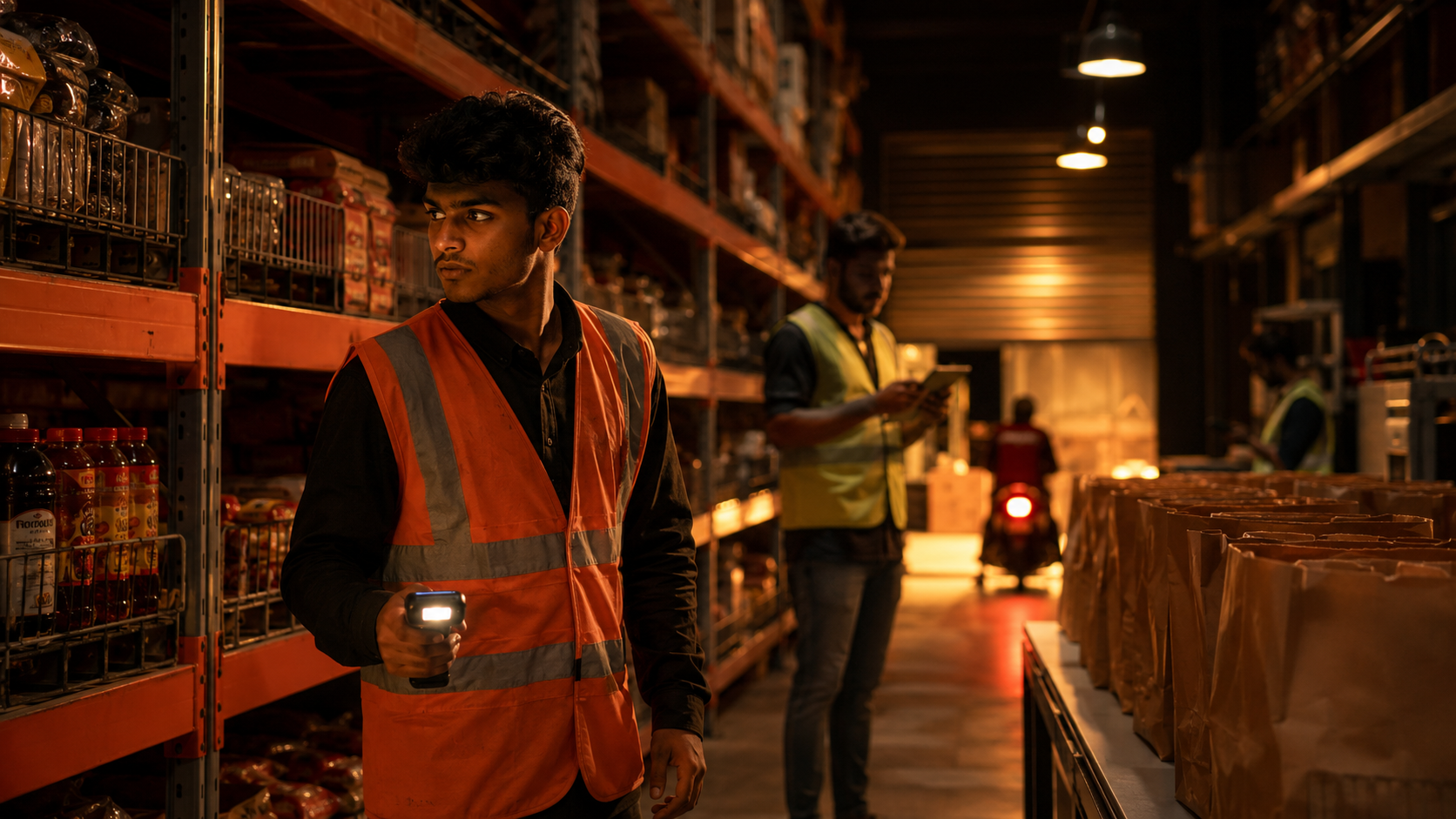
Somewhere within three kilometres of most urban Indian homes, there's a shop that has never let a customer in. The shutters stay half-closed. There's no signage worth noticing. Inside, a dozen workers race handheld scanners through narrow racks, picking grocery orders against a three-minute clock.
That's a dark store. In January 2026, India ran roughly 6,280 of them, processing about 7.8 million orders every day (Redseer, January 2026). Monthly quick-commerce GMV touched ₹11,000 crore — almost exactly double the figure from a year earlier.
This guide explains what dark stores are, how they work hour to hour, why staffing them is harder than building them, and what the law expects from every operator. It draws on Express HR Solutions' own experience staffing and managing dark store operations for retail and quick-commerce clients.
Key Takeaways
- India ran ~6,280 dark stores by January 2026, handling ~7.8 million orders a day (Redseer, January 2026).
- A typical dark store: 1,000–2,000 sq ft, 3,000–45,000 SKUs, a 2–3 km delivery radius, and 8–15 staff.
- 31% of quick-commerce employers rank gig and delivery attrition as their single biggest workforce challenge (TeamLease, HY1 FY 2025-26).
- Dark store staff carry full PF, ESIC, and CLRA obligations — and the 2025 Labour Codes raised the penalties for missing them.
What Exactly Is a Dark Store?
A dark store is a compact warehouse built to serve online orders only — no walk-in customers, no billing counters, no displays. In 2026, a typical Indian dark store occupies 1,000–2,000 sq ft of ground-floor commercial space, stocks 3,000 to 45,000 SKUs, and serves a delivery radius of 2–3 km (RevQ, 2026).
The "dark" simply means closed to the public. Everything else about the space is engineered for speed. Racks are arranged by picking frequency, not shopper psychology. High-velocity items — milk, bread, eggs — sit closest to the packing desk. Slow movers live on the top shelves. There's a cold room, a returns shelf, and a dispatch window where riders collect bagged orders.
Why so small? Because in quick commerce, proximity beats capacity. A 1,500 sq ft store three kilometres from the customer will out-deliver a 50,000 sq ft warehouse on the city's edge, every single time. Dark stores trade scale for density — and then multiply.
How Big Is India's Dark Store Network in 2026?
India operated close to 6,280 dark stores as of January 2026, up from roughly 5,990 just one month earlier (Redseer, January 2026). That's a net addition of nearly 300 stores in a single month. Bernstein analysis cited by Storyboard18 puts the operational count above 6,000, with the top eight cities holding more than 3,800 stores between them.
The platform race explains the pace. Blinkit runs around 2,100 dark stores and has announced another 900 by March 2027. Zepto and Swiggy Instamart operate roughly 1,100–1,200 each. Flipkart Minutes has crossed 800, while Amazon Now has built 450–500, of which 330–370 are live (Storyboard18, 2026).
And this isn't a metro story any more. An independent mapping exercise that pulled store locations from platform APIs found dark stores across 408 cities in 26 states by March 2026 (QuickCommerceMap, April 2026). Demand is keeping up: monthly transacting users grew about 95% year-on-year to roughly 5.2 crore, while average order value held near ₹460 (Redseer, January 2026).
How Does a Dark Store Work, Hour by Hour?
A dark store's day is two loops running in parallel: stock comes in, orders go out. Across India, the average store handled about 1,255 orders per day in January 2026, with leading platforms touching 1,350 (Redseer, January 2026). Spread over an 18-hour operating day, that's nearly one order every 50 seconds.
The inbound loop starts before dawn. Trucks from mother warehouses arrive in the early hours, stock is scanned inward, and putaway crews shelve items zone by zone — expiry-first for perishables, so older stock always ships before newer.
The outbound loop is the famous one. An order lands on a picker's handheld, mapped to a rack route. The picker moves, scans, bags. A packer checks and seals. A rider collects at the dispatch window. In well-run stores, the whole sequence — order receipt to rider handoff — averages under three minutes (RevQ, 2026).
Who makes this happen? A typical roster carries 8–15 people per store: pickers and packers, an inward/inventory executive, shift supervisors, and a store manager (RevQ, 2026). Add housekeeping and you have the full cast.
From our own dark store deployments at Express HR Solutions, the metric that decides whether a store hits its picking SLA isn't total headcount — it's roster discipline. The 6 pm to 10 pm window can carry three times the midday order load. Stores that stagger shift overlaps into that peak hold their three-minute promise. Stores that run flat rosters don't.
Why Is Staffing the Hardest Problem in Quick Commerce?
Attrition beats every other workforce problem in Indian quick commerce. In TeamLease's Employment Outlook Report for HY1 FY 2025-26, 31% of employers ranked attrition among gig and delivery workers as their top challenge — ahead of scalability and time-bound hiring at 25%, and rising cost pressures at 18% (TeamLease, 2025).
The arithmetic shows why this hurts. At 8–15 staff per store across 6,000-plus locations, India's dark stores employ somewhere between 50,000 and 90,000 in-store workers — before counting a single delivery rider. Every percentage point of monthly churn at that scale means thousands of fresh hires: sourcing, verification, induction, uniforms, and two to three weeks of below-par picking speed while new joiners ramp up.
Why do workers leave? Picking targets are physically demanding. Shifts run late. And a rival store two kilometres away will match the salary this week. Quick commerce hires from the same labour pool as warehousing, retail, and food delivery — for a worker, the switching cost is one WhatsApp message.
Across the 15,000+ workers Express HR Solutions deploys on 50+ client sites, our most effective answer to churn is pooled deployment: trained cover staff shared across nearby sites, so one store's absenteeism is another site's surplus shift. Single-store operators can't build that buffer. Multi-site workforce partners can.
What Compliance Obligations Come With Dark Store Staffing?
Dark store workers are contract workers in the full legal sense — PF, ESIC, and CLRA obligations apply from the first shift. Since 21 November 2025, when India's four Labour Codes consolidated 29 labour laws (SCC Online, 2025), the cost of missing those obligations has risen sharply: wage underpayment alone now draws a first-offence fine of up to ₹50,000 (India Briefing, 2025).
Three thresholds matter most:
- ESIC covers employees earning up to ₹21,000 a month in establishments with 10 or more workers. A typical store's 8–15 staff sits right at this line — most stores are in scope from day one.
- EPF applies to establishments with 20 or more employees, covering wages up to ₹15,000 a month at 12% from both employer and employee. Contractors aggregate workers across sites, so the 20-employee test is met almost immediately.
- CLRA requires principal employer registration and contractor licensing once 20 or more contract workers are engaged. One store may sit below the threshold; a city cluster of five stores under one contractor doesn't.
And liability flows upward. If the staffing contractor defaults on PF or ESIC, the principal employer — the brand whose name is on the app — pays first and recovers later. We covered the full mechanics, penalties, and monthly verification workflow in our statutory compliance guide for contract workers.
Under India's Labour Codes, effective 21 November 2025, dark store staffing carries the same statutory weight as factory employment: ESIC from 10 workers, EPF from 20 employees, CLRA registration from 20 contract workers — and principal employers stay jointly liable whenever their contractors default.
Should You Run Dark Store Operations In-House or Outsource?
Most quick-commerce platforms and retail brands outsource dark store staffing, and the TeamLease numbers explain why: 25% of employers name scalability and time-bound hiring as a top challenge, and 31% attrition pressure makes hiring a permanent activity, not a one-time project (TeamLease, 2025). The real question isn't headcount supply. It's who absorbs the churn, the compliance exposure, and the peak-hour rostering.
| Factor | In-house | Workforce partner |
|---|---|---|
| Hiring speed at new-store launch | Your TA team, store by store | Pre-trained pools deployed in days |
| Attrition cover | Vacancy until replaced | Pooled cover staff across sites |
| PF / ESIC / CLRA filings | Your liability, your bandwidth | Partner-managed, audit-ready |
| Peak-hour rostering | Fixed shifts | Flexible deployment across stores |
| Cost structure | Fixed salaries plus overheads | Per-position, scales with store count |
What should you demand from a workforce partner? Monthly proof, not promises:
- ECR challans that match your deployed headcount, every month.
- ESIC deposit confirmations inside the statutory 21-day deadline.
- CLRA licences covering the correct state and industry category.
- A supervisor layer that owns roster discipline and shift cover — not just payroll processing.
This is the model Express HR Solutions runs. We deploy 15,000+ workers across 50+ sites in 10+ states, manage over 20 lakh sq ft of warehousing and retail space, and maintain a 100% statutory compliance record across PF, ESIC, and labour-law filings. Dark store management is one of our named service lines — staffing, supervision, and compliance under one contract.
Frequently Asked Questions
How many dark stores does India have in 2026?
Roughly 6,280 as of January 2026, per Redseer's monthly tracking — up from about 5,990 in December 2025. Bernstein analysis places the count above 6,000, and an independent API-based mapping found stores operating in 408 cities across 26 states by March 2026.
How many people work in a dark store?
A typical Indian dark store rosters 8–15 staff: pickers, packers, an inventory executive, shift supervisors, and a store manager (RevQ, 2026). With the average store processing about 1,255 orders a day (Redseer, January 2026), simple division puts a picker's shift load above a hundred orders.
Are dark store workers covered by PF and ESIC?
Yes. ESIC applies to employees earning up to ₹21,000 a month in establishments with 10 or more workers; EPF covers wages up to ₹15,000 in establishments with 20 or more employees. Contract staffing doesn't dilute this — principal employers carry joint liability if contractors default.
How fast does a dark store fulfil an order?
In well-run stores, picking, packing, and rider handoff average under three minutes from order receipt (RevQ, 2026). The 10-minute customer promise is mostly a function of distance: each store serves a 2–3 km radius, which keeps riding time to a few minutes.
What's the difference between a dark store and a warehouse?
Size, radius, and rhythm. A warehouse measures lakhs of square feet, serves a region, and ships in bulk on truck schedules. A dark store is 1,000–2,000 sq ft, serves a 2–3 km neighbourhood, and dispatches individual orders within minutes, hundreds of times a day.
Conclusion
Dark stores are warehouses wearing a shop's clothes — small, dense, and entirely dependent on the people inside them. India crossed 6,000 of them by early 2026, and platform expansion targets point well past that number by 2027.
The hard part isn't the real estate. It's keeping a trained, compliant, fully-rostered team inside every one of those stores, every shift, against 31% attrition pressure. That's a workforce problem before it's a logistics one — and it rewards operators who treat staffing as seriously as site selection.
Need help managing workforce compliance? Get in touch with Express HR Solutions.
Sources
- Redseer, "Quick Commerce in 2026: Scale, Category Mix & Profit Momentum". Retrieved 2026-06-12. https://redseer.com/articles/quick-commerce-finds-its-new-normal-with-scale-mix-and-momentum/
- Storyboard18, "Dark Stores Explained: How Blinkit, Zepto Are Building Dense Networks for Quick Commerce Growth". Retrieved 2026-06-12. https://www.storyboard18.com/trending/dark-stores-explained-how-blinkit-zepto-are-building-dense-networks-for-quick-commerce-growth-95233.htm
- RevQ, "Dark Stores Explained: The Infrastructure Behind Quick Commerce in India (2026)". Retrieved 2026-06-12. https://www.revq.in/dark-stores-explained-the-infrastructure-behind-quick-commerce-in-india-2026
- QuickCommerceMap, "India Quick Commerce Map 2026: 4,081 Dark Stores Mapped". Retrieved 2026-06-12. https://quickcommercemap.com/reports/india-quick-commerce-map-2026
- TeamLease, "Workforce Challenges in Quick Commerce: Scaling Under Pressure". Retrieved 2026-06-12. https://group.teamlease.com/article/workforce-challenges-in-quick-commerce-scaling-under-pressure/
- SCC Online, "Enforcement Dates of Labour Codes". Retrieved 2026-06-12. https://www.scconline.com/blog/post/2025/11/26/enforcement-dates-of-labour-codes-legal-news/
- India Briefing, "India Labor Code Penalties Guide 2025". Retrieved 2026-06-12. https://www.india-briefing.com/news/india-labor-code-penalties-guide-2025-41211.html/